Reviewed by Dr. Bruce Vafa, DDS, MS (Orofacial Pain and Oral Medicine, USC). Last reviewed August 2026.
If you wake up with a sore jaw, a dull headache, or the feeling that you have been chewing all night, you may be grinding your teeth. The medical term is bruxism, and most people who have it do not know until a partner mentions the sound or a dentist spots the wear.
For years the standard answer has been a plastic night guard. A guard protects the enamel, and it has its place. But it covers the problem rather than solving it. The more useful question is why the grinding is happening at all, because the answer is often something treatable.
This guide covers what bruxism is, what causes it, and how it can be treated, including the approaches we use at our West Hollywood office.
What is bruxism?
Bruxism is repeated clenching, grinding, or bracing of the jaw. Dental researchers separate it into two types by when it happens: sleep bruxism and awake bruxism. They have different patterns and often different causes.
It is common. A 2024 systematic review and meta-analysis in the Journal of Clinical Medicine estimated global prevalence at about 21% for sleep bruxism and 23% for awake bruxism, with the authors noting that roughly one in four people may experience awake bruxism.1 An earlier systematic review found awake bruxism in 22% to 31% of adults.2 Estimates vary between studies because most rely on self-reporting, and many people are unaware they grind at all.
The forms it takes
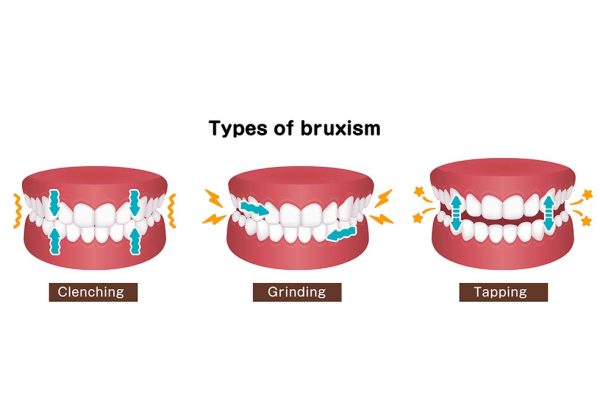
Clenching is sustained, forceful tightening of the jaw with no side-to-side motion. It usually happens during the day, often without you noticing, in response to stress or concentration. The signs are tender jaw muscles, headaches, and flattened tooth surfaces.
Grinding is the back-and-forth movement of teeth against each other. It is more common during sleep. The signs are tooth sensitivity, worn enamel, chipped or flattened teeth, and sore facial muscles.
Bracing and thrusting means holding the jaw rigid or pushing it forward without the teeth necessarily moving against each other. It is included in the current international definition of bruxism and can cause muscle pain without the obvious tooth wear that makes grinding easier to spot.
Signs to watch for
- Grinding sounds at night, often noticed by someone else
- Headache, jaw ache, or earache on waking
- Worn, flattened, or chipped tooth surfaces
- Tooth sensitivity that has no obvious cause
- Tight or sore jaw muscles
- Indentations along the edge of the tongue or inside the cheek
- Waking unrested after a full night’s sleep
Why it matters if it goes untreated
Grinding applies far more force to teeth than normal chewing, and it does so for hours. Over time that causes enamel wear, cracked or fractured teeth, and in severe cases tooth loss. Repeated strain on the jaw joint can lead to TMJ problems: pain, clicking, and difficulty opening or closing the mouth. Chronic muscle tension in the jaw is also a common source of headaches and facial pain that get treated as migraines for years without anyone checking the bite.
It is worth saying that bruxism is not always harmful. Current thinking in the field treats it as a behavior rather than automatically a disorder, one that can range from harmless to damaging depending on its intensity and its effects.3 What matters is whether it is causing wear, pain, or disrupted sleep in your particular case. That is what an exam is for.
What causes it
There is rarely a single cause. In practice it is usually several things at once.
Stress and anxiety
The most commonly reported driver, particularly for awake bruxism. Under stress the body tenses, and if that tension is not released physically it often settles in the jaw. Daytime clenching frequently carries over into night grinding.
Sleep-disordered breathing
Sleep bruxism and obstructive sleep apnea are associated, and people with one are more likely to have the other. The relationship is still being studied, and researchers have not established that one causes the other. What is clear clinically is that when someone grinds at night and also snores, wakes unrested, or has been told they stop breathing in their sleep, the airway is worth evaluating. Treating a breathing problem sometimes resolves grinding that a night guard was only masking.
Bite misalignment
If the teeth do not meet evenly, the jaw muscles may not find a comfortable resting position. Bite factors are considered less influential than they once were, but they still matter in individual cases, especially where recent dental work changed how the teeth come together.
Medications and lifestyle
Caffeine, alcohol, and tobacco use are associated with higher rates of bruxism. Certain medications list teeth grinding as a side effect, including some SSRIs and other antidepressants. If your grinding started after a medication change, that is worth mentioning to both your dentist and your prescriber.
How we approach treatment
Our approach is to protect the teeth while also looking for what is driving the grinding. That usually means a combination of the following.
A thorough evaluation first
We assess wear patterns, jaw alignment, muscle tenderness, and range of motion, and we ask about sleep, stress, medications, and diet. Dr. Bruce Vafa holds a Master of Science in Orofacial Pain and Oral Medicine from USC, so jaw pain and its causes are a particular focus of this practice rather than an afterthought.
A custom night guard, made from biocompatible materials
A properly fitted guard protects teeth from further wear and can ease muscle tension. Ours are made from metal-free, biocompatible materials, consistent with how we handle every restoration here. A custom guard fits and functions differently from a drugstore boil-and-bite version, which can sometimes make clenching worse by giving the jaw something to push against.
Addressing the bite
Where misalignment appears to be contributing, correcting it can remove a cause rather than manage a symptom. Depending on the case that might mean orthodontic treatment, adjustment of high spots, or restoring worn teeth to their proper shape.
Nutrition and lifestyle review
We talk about caffeine, alcohol, evening routine, and stress, because these are the factors most consistently linked to bruxism and the ones you have the most control over. Where diet appears relevant we discuss it as part of your overall care. This supports dental treatment rather than replacing it.
Airway assessment
If the pattern points toward sleep-disordered breathing, we evaluate it and refer for a sleep study where that is appropriate. Diagnosing sleep apnea is a medical matter, not a dental one, but dentists are often the first to notice the signs.
What you can do at home
“Lips together, teeth apart.” Your teeth should only touch when you swallow. Through the day, check in: if your teeth are together, let the jaw drop, breathe through your nose, and rest the tip of your tongue on the roof of your mouth behind the front teeth. That is the natural resting position, and it makes grinding physically impossible.
Jaw massage. Gently rub the large muscles just in front of your ears with your knuckles. If you find a tender spot, hold light pressure for about 30 seconds until it releases.
Progressive muscle relaxation before bed. Tense and then release each muscle group in turn, from your feet upward, finishing with the jaw and face. It teaches your body what a relaxed jaw feels like.
Wind down properly. Less screen time, no caffeine late in the day, and a consistent bedtime all help. Stress reduction is not a soft recommendation here; it addresses the most commonly reported cause.
These help, but they are not a substitute for an exam. If your teeth are already worn or your jaw hurts most mornings, there is damage happening that home care will not reverse.
Bruxism, TMJ, and jaw pain treatment in West Hollywood
Teeth grinding and TMJ problems often travel together, and both respond better to early treatment than to years of managing symptoms. If you are waking with jaw pain or headaches, or someone has told you that you grind at night, we can look at what is causing it.
Our practice is at 7865 Santa Monica Blvd in West Hollywood, and new patients are welcome for a free consultation. Call (323) 654-2840 or book an appointment.
Related reading
References
- Zieliński G, Pająk-Zielińska B, Ginszt M. Global Prevalence of Sleep Bruxism and Awake Bruxism in Pediatric and Adult Populations: A Systematic Review and Meta-Analysis. Journal of Clinical Medicine. 2024;13(14):4259. Available here
- Manfredini D, Winocur E, Guarda-Nardini L, Paesani D, Lobbezoo F. Epidemiology of Bruxism in Adults: A Systematic Review of the Literature. Journal of Orofacial Pain. 2013;27(2):99-110. Available here
- Lobbezoo F, Ahlberg J, Raphael KG, et al. International consensus on the assessment of bruxism: Report of a work in progress. Journal of Oral Rehabilitation. 2018;45(11):837-844. Available here