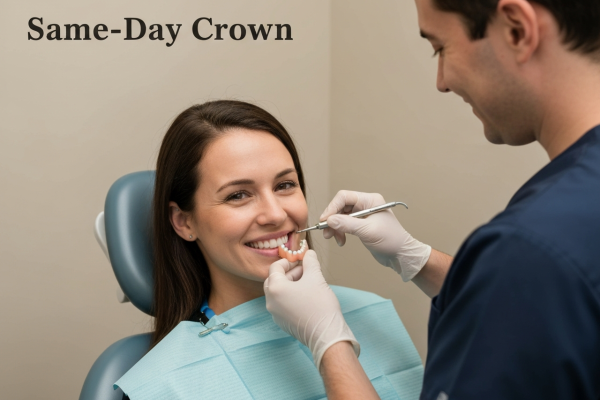
Imagine walking into my dental office with a chipped tooth or an old, failing filling and walking out less than two hours later with a brand-new, permanent ceramic restoration. No temporary crowns to worry about. No second appointment two weeks later. Just a beautiful, healthy smile in a single visit. As a dentist, I have seen how much anxiety traditional dental work can cause, and that is why I am so passionate about the advancements we have made in technology.
For years, getting a dental crown was a waiting game. You had to bite into messy, goopy impression material that made you want to gag. Then, you wore a fragile temporary plastic cap that might fall off while you were eating dinner. Finally, you had to come back for a second shot of anesthesia to get the permanent tooth cemented. It was a hassle.
Today, I am proud to offer a better way. Through same-day dentistry, I can restore your teeth using high-quality, biocompatible materials while you sit comfortably in the chair. This isn’t just about speed; it is about preserving your natural tooth structure and using materials that work in harmony with your body.
What Exactly Is Same-Day Dentistry?
When I talk about same-day dentistry, I am referring to a process that uses Computer-Aided Design and Computer-Aided Manufacturing, often called CAD/CAM technology. This technology allows me to design, create, and place dental restorations—like crowns, veneers, inlays, and onlays—right here in the office.
In the past, dentists relied on off-site laboratories to make these pieces. That is why it took weeks. Now, I have a complete “lab” sitting right next to my dental chair. This shift has completely changed the patient experience. It puts the control back in my hands, allowing me to customize the fit and look of your tooth with incredible precision.
This method is not new, but it has been refined to a point of perfection. We are no longer guessing; we are using digital mapping to ensure your bite is perfect. For anyone with a busy schedule or dental anxiety, this technology is a game-changer.
The Power of Biocompatible Materials
As Dr. Bruce Vafa, I believe that dentistry should be holistic. We shouldn’t just fix a hole in a tooth; we should consider how the repair affects your entire body. This is where biocompatible materials come into play.
In traditional dentistry, crowns were often made of metal alloys fused to porcelain. While strong, these metals can sometimes cause gum irritation or allergic reactions in sensitive patients. Furthermore, they often leave that unsightly gray line at the gum level.
With same-day dentistry, I primarily use high-grade dental ceramics and porcelain blocks. These materials are biocompatible. This means they are chemically stable and non-toxic. Your body accepts them much like it accepts your natural enamel. They do not conduct heat and cold as sharply as metal, which means you are likely to have less sensitivity after the procedure.
Additionally, these ceramic materials bond directly to your tooth structure. This bonding process seals the tooth more effectively, preventing bacteria from leaking back underneath the restoration. It creates a seamless integration between the restoration and your natural tooth.
According to the American Dental Association, all-ceramic crowns provide a better natural color match than any other crown type and are usually more suitable for people with metal allergies.
The Step-by-Step Process: A Day in the Chair
You might be wondering, “How does Dr. Vafa actually do this in one visit?” Let me walk you through the workflow so you know exactly what to expect.
1. Digital Impressions (No More Goop)
First, I prepare the damaged tooth by removing decay or old filling material. Instead of using that uncomfortable impression paste, I use a small intraoral camera. I wave this wand over your teeth, and it captures thousands of images per second. These images are stitched together to create a perfect 3D digital model of your mouth on my computer screen.
2. The Design Phase
This is where the artistry happens. Using specialized software, I design your new restoration right in front of your eyes. I can adjust the shape, size, and contours to match your surrounding teeth perfectly. You can actually watch your new tooth being created on the monitor. This ensures that the contact points with your other teeth are precise, preventing food from getting stuck.
3. Milling the Restoration
Once I am happy with the design, I send the data to my in-office milling machine. You can think of this machine as a very precise 3D printer and carver combined. I place a block of biocompatible ceramic—chosen to match your specific tooth shade—into the machine. Within 10 to 15 minutes, diamond burs carve your custom crown or filling out of that solid block.
4. Sintering and Polishing
Depending on the material we use, the tooth might go into a specialized oven to bake (sinter). This hardens the material, making it incredibly durable. After that, I polish the restoration or apply a glaze to make it look exactly like a natural tooth.
5. Bonding and Placement
Finally, I place the new restoration in your mouth to check the fit. Once we are both satisfied, I bond it permanently to your tooth. You walk out ready to eat, drink, and smile.
Why One-Visit Restorations Are Superior
I advocate for this method not just because it is cool technology, but because it offers tangible health benefits over traditional methods.
Preservation of Tooth Structure
Because the digital bonding is so precise, I can often be more conservative with your tooth. I only need to remove the damaged tissue. Traditional crowns often require grinding down more of the healthy tooth to ensure the metal cap fits. My goal is always to keep as much of your natural tooth as possible.
Better Seal and Protection
Temporary crowns are notorious for leaking. While you wait two weeks for a lab crown, bacteria can sometimes creep under the temporary cap and infect the sensitive dentin. By finishing the process in one appointment, we seal the tooth immediately. This drastically reduces the risk of infection and sensitivity.
Aesthetic Excellence
The ceramic blocks we use mimic the translucency of natural enamel. Light passes through them just like it does with real teeth. This eliminates the “flat” look that some older crowns have. Nobody will know you have had dental work done.
Data Point: Success Rates
You might worry that doing things faster means sacrificing quality. The data proves otherwise. Research and clinical studies have shown that CAD/CAM restorations have a survival rate of approximately 95.5% over a 10-year period. This is statistically comparable to, and in some cases better than, traditional gold or metal-ceramic restorations. Speed does not mean cutting corners; it means using better engineering.
Comparing the Timeline
To help you visualize how much time you save with same-day dentistry, I have broken down the typical timeline of a traditional crown versus the method I use in my practice.
Time Investment Comparison
Traditional Crown Process (2-3 Weeks)
Same-Day Dentistry (One Visit)
*Visualization of total time from start to final permanent placement.
The Economic Value of Your Time
I know that dental work is an investment. However, when you consider the cost, you must also consider the value of your time. Traditional dentistry requires you to take time off work twice. It requires you to drive to the office twice. It involves twice the amount of numbing injections.
With same-day dentistry, you are only taking a long lunch break or a couple of hours out of your morning. For my professional patients, this efficiency is invaluable. You are saving on gas, childcare, and lost wages.
Who Is a Candidate for This Procedure?
Almost everyone is a candidate for same-day restorations. Whether you have a cracked molar, a large cavity that a filling can’t fix, or you want to replace an old, dark metal filling with white porcelain, this technology works.
However, there are rare cases where a tooth is fractured below the gum line or requires complex bridging where I might still recommend a lab-fabricated piece. But for 90% of the restorative work I do, the digital one-visit method is my first choice.
Data Point: Precision Fit
The digital scanners I use are accurate to within 20 microns. To give you some perspective, a human hair is about 70 microns thick. This level of precision ensures that the gap between your tooth and the restoration is microscopic, which significantly lowers the risk of future decay developing at the margins.
My Philosophy on Patient Care
I have always believed that going to the dentist should not be a traumatic experience. By integrating same-day dentistry into my practice, I am able to offer a level of service that respects your body and your schedule.
The biocompatible materials I use ensure that we are not introducing potential allergens into your system. The digital workflow ensures you are comfortable and not gagging on impression trays. The speed ensures you can get back to your life quickly. It is a win-win situation for both me and my patients.
Frequently Asked Questions
Is same-day dentistry more expensive than traditional crowns?
Generally, the cost is very similar to traditional crowns. While the equipment we use is expensive, we save money on outside laboratory fees and shipping costs. I pass those savings of time and resources on to the patient. Most dental insurance plans cover same-day crowns exactly the same way they cover traditional crowns.
Are these crowns as strong as regular crowns?
Yes. The ceramic blocks we use are industrially manufactured under high pressure, making them free of the internal flaws that can sometimes occur in hand-layered lab porcelain. Once bonded to your tooth, they restore the tooth to its original strength.
Does the digital scanning process hurt?
Not at all. The scanner is just a small wand that hovers over your teeth. There is no radiation involved (it uses light), no pain, and no bad taste. It is one of the easiest parts of the procedure.
How long will a same-day restoration last?
With proper care—meaning brushing, flossing, and regular check-ups—these restorations can last 10 to 15 years or even longer. They are subject to the same wear and tear as natural teeth, so avoiding chewing on ice or hard candy will help extend their lifespan.
Can you do multiple teeth in one day?
Absolutely. Because the milling machine does the hard work while you relax, we can prepare and restore multiple teeth in a single appointment. This is perfect for patients who want a smile makeover without dragging it out over months.
Your Smile, Simplified
We are living in a golden age of dental technology. There is no longer a need to endure temporary patches or long waits to get your health back on track. By combining speed, comfort, and biocompatible science, same-day dentistry represents the standard of care that I believe every patient deserves.
If you have a damaged tooth or simply want to upgrade your old metal fillings to natural-looking ceramic, I am here to help. My goal is to get you healthy, keep you comfortable, and send you out the door with a smile that looks and feels like you.