Hello, I am Dr. Bruce Vafa. Welcome to my holistic dental blog. Today, I want to have an honest, open conversation with you about a topic that is often brushed under the rug in traditional dentistry.
When you have a severe toothache, the pain can be overwhelming. You just want it to stop. For decades, the standard solution offered by most dentists has been the root canal. It is often presented as the “hero” procedure that saves the tooth. But as a holistic dentist, I look at the body as a whole system, not just a collection of isolated parts. This perspective forces us to ask difficult questions about the long-term safety of keeping dead tissue inside your body.
In this article, we are going to explore the potential root canal dangers that many patients are never told about. We will look at toxicity concerns, the science of bacterial infection, and most importantly, the positive, safer alternatives that can protect your overall health.
Understanding the Anatomy of a Tooth
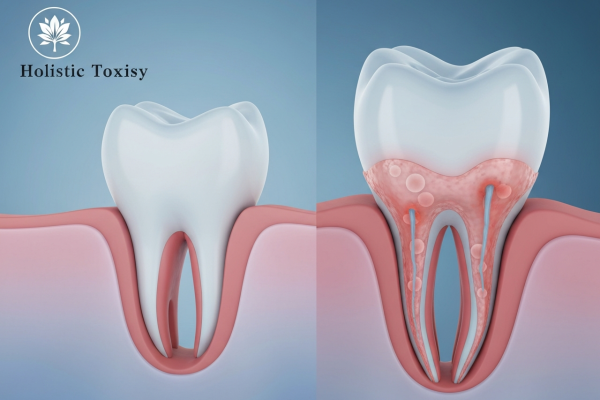
To understand why a root canal might be problematic, we first need to understand what a tooth actually is. A tooth is not solid rock. It is a living organ. Inside the hard outer enamel, there is the dentin, and inside that is the pulp chamber. This chamber is full of blood vessels, nerves, and connective tissue. It is very much alive.
When a tooth becomes infected or decays deeply, that pulp tissue dies. In any other branch of medicine, if an organ dies—like an appendix or a toe with gangrene—surgeons remove it. Leaving dead tissue in the body is generally considered a recipe for infection. However, the root canal procedure aims to keep this dead structure in your mouth by scraping out the nerve and sealing it up.
The Problem with Dentinal Tubules
This is where the biology gets complicated. The dentin (the layer under the enamel) is made up of miles of microscopic tubes called dentinal tubules. If you were to stretch out the tubules from a single front tooth, they would stretch for roughly three miles. These tubes are wide enough for bacteria to enter, but often too narrow for white blood cells or antibiotics to reach effectively.
Data Point 1: Research indicates that a single human incisor contains approximately 3 miles of these microscopic dentinal tubules. This creates a massive surface area for bacteria to hide, which mechanical cleaning cannot physically reach completely.
When a root canal is performed, the main canals are cleaned, but these miles of microscopic tubules remain. Once the blood supply is cut off, the tooth becomes a dead organ. Anaerobic bacteria (bacteria that can live without oxygen) can retreat into these tubules. Protected from your immune system and antibiotics, they can multiply and produce toxins.
The Toxicity Concern: What is Hiding in Your Tooth?
The primary concern regarding root canal dangers revolves around these trapped bacteria. Because the tooth is dead, there is no blood flow to bring immune cells to fight the bacteria. Instead, the tooth can become an incubator.
These bacteria can morph to survive in an oxygen-free environment. As they digest dead tissue and fluids leaking from surrounding gums, they release waste products. These waste products are often highly toxic thioethers and thio-ethanols. In the holistic dental community, we worry that these toxins do not just stay in the tooth.
Every time you chew or grind your teeth, the pressure can pump these toxins out of the tooth and into your bloodstream/lymphatic system. This leads us to the concept of the “Focal Infection Theory.” This theory suggests that a localized infection (like a root canal tooth) can affect distant organs in the body.
Visualizing Bacterial Growth Potential
The graph below illustrates the potential bacterial load comparison between a healthy vital tooth and a root-canaled tooth over time without immune defense.
Immune system actively manages bacteria.
Anaerobic bacteria begin colonizing tubules.
High toxicity potential due to lack of blood supply.
Systemic Health Connections
As a biological dentist, I always look at the mouth-body connection. Your teeth are not isolated; they are connected to your meridian system (energy pathways used in acupuncture) and your blood supply. When we discuss root canal dangers, we are looking at potential links to systemic diseases.
While the American Dental Association maintains that root canals are safe, various independent researchers and holistic practitioners have observed correlations between root canal teeth and chronic health issues. The concern is that the constant low-grade inflammation and toxin release may burden the immune system.
Data Point 2: Studies utilizing DNA analysis of root canal teeth have identified up to 53 different species of bacteria within the treated teeth, many of which are known to affect the heart, nervous system, and kidneys.
Some of the conditions that holistic researchers investigate for links to oral pathology include:
- Cardiovascular Disease: Inflammation is a key driver of heart disease.
- Autoimmune Disorders: A hyper-active immune system trying to fight a hidden infection.
- Chronic Fatigue: Energy drain from constant immune defense.
- Joint Pain: Bacterial byproducts can sometimes settle in joints.
- Brain Health: Links between oral bacteria and neurological health are currently being heavily researched.
For more in-depth reading on how oral health impacts the rest of the body, you can read this study from the National Institutes of Health (NIH) on systemic diseases caused by oral infection.
Safer, Holistic Alternatives
Now, let’s shift to the positive news. If we decide that the risks of keeping a dead tooth are too high, what can we do? You do not have to live with a gap in your smile. Modern dentistry offers incredible, biocompatible alternatives that look and feel natural.
1. Safe Extraction and Cleaning
The first step is often removing the infected tooth. However, simply pulling the tooth isn’t enough. We must remove the periodontal ligament (the connective tissue holding the tooth) and clean the socket thoroughly. We often use ozone therapy—a powerful form of oxygen—to disinfect the area naturally and stimulate healing. This prevents a “cavitation,” which is a pocket of infection that can form in the jawbone if it doesn’t heal correctly.
2. Zirconia Implants (Metal-Free)
In the past, titanium implants were the only option. While better than a root canal for some, titanium is a metal, and some people have sensitivities to it. Today, we have Zirconia implants. Zirconia is a ceramic material that is:
- Biocompatible: The gum tissue loves it and grows around it beautifully.
- Metal-Free: No risk of corrosion or metal allergies.
- Aesthetic: It is white like a natural tooth, so no gray metal shows through the gums.
- Hypoallergenic: It creates a very neutral response in the body.
3. Dental Bridges
If an implant isn’t right for you, a metal-free bridge (made of Zirconia or porcelain) can replace a missing tooth by anchoring to the neighboring teeth. This is a fixed, stable solution that does not require surgery into the bone.
4. Removable Partials
For patients who want a non-surgical, lower-cost option, modern flexible partial dentures are comfortable and metal-free. They are an excellent temporary or permanent solution to restore function and aesthetics.
Preventative Care: The Best Medicine
Of course, the absolute best alternative to a root canal is never needing one in the first place. This is where my passion for prevention comes in. By maintaining a diet rich in minerals, vitamins (especially Vitamin K2 and D3), and avoiding processed sugars, we can keep the pulp of the tooth healthy.
Regular checkups with a holistic dentist allow us to catch decay when it is small and reversible, using ozone therapy or remineralization techniques rather than drilling deeply into the nerve.
Frequently Asked Questions (FAQ)
Are all root canals dangerous?
It is not that every root canal will cause an immediate disease. The concern is about the potential for long-term chronic infection. Every person’s immune system is different. Some people tolerate root canals for years, while others may experience a decline in health. As a holistic dentist, I believe in removing the burden of toxicity to ensure the best chance for optimal health.
If I already have a root canal, should I remove it?
This is a personal decision that should be made after a thorough evaluation. We often use 3D Cone Beam imaging to look for signs of infection in the bone that regular X-rays might miss. If you have a root canal and are suffering from unexplained chronic health issues, it is worth investigating whether the tooth could be a contributing factor.
Is extraction painful?
Modern extraction techniques are very gentle. We use local anesthesia to ensure you are comfortable. With proper holistic protocols, including the use of PRF (Platelet Rich Fibrin) where we use your own blood’s healing factors, recovery is often very quick and comfortable.
Why don’t all dentists talk about root canal dangers?
Dental school training focuses heavily on saving the tooth structure at all costs. The mechanical success of the procedure (the tooth stays in the mouth) is often prioritized over the biological success (systemic health). Biological dentistry requires additional training and a different philosophy that prioritizes the whole body over just the tooth mechanics.
What is Ozone Therapy?
Ozone is a gas composed of three oxygen atoms. It is naturally antibacterial, antiviral, and antifungal. We use it to sterilize cavities and extraction sites. It kills pathogens on contact without the toxic side effects of harsh chemicals, making it a staple in my holistic practice.
Empowering Your Health Choices
My goal as Dr. Bruce Vafa is not to scare you, but to empower you. Knowledge is the most important tool you have. When you understand the biology of your teeth and the potential root canal dangers involving toxicity and infection, you can make informed decisions.
You have choices. You can choose materials that work with your body, not against it. You can choose procedures that prioritize your immune system. Whether it is preventing decay through nutrition or choosing a Zirconia implant over a root canal, the path to a healthy smile should also be the path to a healthy life. Your mouth is the gateway to your body, and treating it with care and respect is the foundation of total wellness.