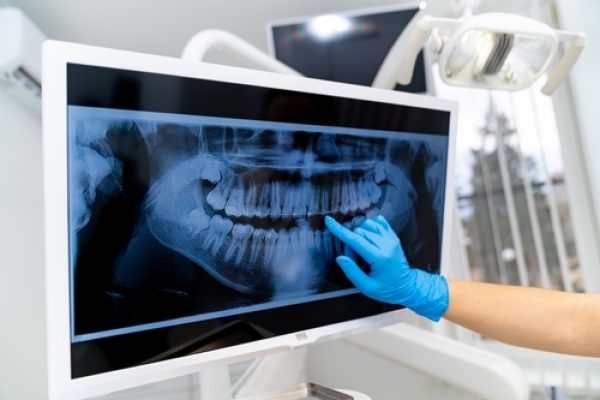
When you walk into my dental practice, my goal is always the same: to give you the best possible care with the least amount of discomfort. For decades, dentists relied on flat, two-dimensional X-rays. While those little black and white films were helpful, they often left us guessing about the depth of a tooth or the exact curve of a root. Today, I am proud to say that guessing games are a thing of the past.
Welcome to the era of digital dentistry. Specifically, I want to talk to you about a game-changing technology I use every day: 3D imaging and the CBCT scan. If you have ever wondered how we can place an implant so perfectly or find a hidden infection that doesn’t show up on a regular X-ray, this technology is the answer. It allows me to see your mouth, jaw, and nerves in incredible detail, ensuring that your treatment is safe, precise, and successful.
What Exactly is a CBCT Scan?
You might have heard the term “CT scan” in a hospital setting. In dentistry, we use something similar but much more specialized called Cone Beam Computed Tomography, or a CBCT scan. Unlike medical CT scans that use a fan-shaped beam and deliver a higher dose of radiation, the dental CBCT uses a cone-shaped beam.
Here is how it works: The machine rotates once around your head. It takes hundreds of distinct images in less than a minute. Then, powerful computer software stitches these images together to create a perfect 3D replica of your teeth, jawbone, and soft tissues. I can rotate this digital model, zoom in, and look at your anatomy from every single angle.
Think of a standard 2D X-ray like a painting of a loaf of bread. You can see the crust, but you can’t tell if there is a raisin hidden in the middle of a slice. A CBCT scan is like having the actual loaf of bread in your hands; you can slice it virtually and see exactly what is happening inside. This level of detail is crucial for making the right decisions about your health.
Why I Choose 3D Imaging for My Patients
I believe that to do great work, I need to see the full picture. Standard X-rays are still useful for checking cavities between teeth, but they have limitations. They distort images and flatten 3D objects onto a 2D surface. This can hide problems or make things look different than they really are.
By using 3D imaging, I can spot issues that would otherwise remain invisible until they caused you pain. This technology fits perfectly into my philosophy of proactive and precise care. It takes the “maybe” out of the equation. When I look at your scan, I know exactly how much bone you have, where your nerves run, and the precise shape of your tooth roots.
For more information on the safety and regulations of these devices, you can read this article from the FDA on Dental Cone Beam Computed Tomography.
The Impact of Precision on Your Treatment
The biggest winner with this technology is you, the patient. When I have better data, your treatment becomes faster, safer, and more comfortable. Here is how I apply this technology across different procedures in my office.
Dental Implants
Placing a dental implant is an art and a science. I need to place a titanium post into your jawbone to act as a new root. Before CBCT technology, we had to estimate the bone width. If the bone was too thin, we might not find out until surgery started.
With a CBCT scan, I can virtually place the implant on the computer screen before you even sit in the dental chair. I can measure the bone density and volume to the millimeter. I can also see exactly where the major nerves and sinuses are located to avoid touching them. This digital planning leads to much higher success rates and faster healing times for my patients.
Root Canal Therapy
Root canals have a bad reputation, largely because of older techniques. Teeth often have tiny, extra canals that are impossible to see on a 2D X-ray. If a dentist misses one of these canals, the infection stays, and the root canal fails.
Using 3D imaging, I can navigate the complex root systems of your teeth like a map. I can see the curvature of the roots and identify the exact number of canals. This ensures I clean out the entire infection the first time, saving your tooth and preventing the need for retreatment.
Wisdom Teeth Extractions
Wisdom teeth, or third molars, often sit very close to the large nerve running through your lower jaw. On a 2D X-ray, the roots might look like they are touching the nerve, but it is hard to tell for sure. A 3D scan shows me the exact relationship between the tooth and the nerve. This allows me to plan the extraction carefully to minimize any risk of nerve damage.
Data That Proves the Difference
I don’t just use this technology because it looks cool; I use it because it is proven to improve patient outcomes. Let’s look at the numbers.
Data Point 1: According to research published in the Journal of Endodontics, traditional 2D X-rays only detect the signs of dental infection in the bone (periapical lesions) about 35% to 58% of the time. In contrast, 3D CBCT scans have demonstrated the ability to detect these same infections with nearly 100% accuracy. That is a massive difference in catching disease early.
This difference in accuracy directly affects how I treat you. If I can’t see the infection, I can’t treat it. 3D imaging ensures nothing gets missed.
Detection of Bone Infections: 2D vs. 3D Imaging
Visual representation of diagnostic sensitivity based on endodontic research data.
The Patient Experience: What to Expect
If I recommend a CBCT scan for you, you might be wondering what the experience is actually like. I find that many patients are pleasantly surprised by how easy it is compared to traditional dental impressions or lengthy X-ray processes.
There is no need to bite down on uncomfortable plastic tabs that poke the roof of your mouth. You will simply stand or sit in the machine. I will position you carefully to ensure your head is stable. The machine is open and airy, so you won’t feel closed in like you might in a hospital MRI machine.
The scanner arm rotates around your head once. It is completely silent or makes a very quiet humming noise. The whole scan takes between 10 to 40 seconds. That’s it. Within minutes, the 3D image pops up on my computer screen, and we can look at it together. I love this part of the appointment because it allows me to co-diagnose with you. I can point to the screen and show you exactly what is going on, helping you understand why a specific treatment is necessary.
Safety and Radiation: Putting Your Mind at Ease
I know that radiation is a concern for many patients. It is a valid concern, and I take it very seriously. However, digital dentistry has come a long way regarding safety.
Because the CBCT technology uses a focused cone beam rather than a fan beam, it focuses only on the area we need to see. This significantly reduces scatter radiation. Furthermore, digital sensors are much more sensitive than old-fashioned film, meaning they require far less radiation to capture a clear image.
Data Point 2: To put it in perspective, the radiation exposure from a standard dental CBCT scan is significantly lower than a medical CT scan. A medical CT of the head can expose a patient to approximately 2,000 microsieverts of radiation. A focused dental CBCT scan typically ranges from 5 to 600 microsieverts depending on the field of view, with many localized scans being on the very low end of that spectrum. This is comparable to the background radiation you would naturally absorb just by living your daily life for a few days to a week.
In my practice, I adhere strictly to the ALARA principle: “As Low As Reasonably Achievable.” I only prescribe a scan when it is necessary for your diagnosis or treatment plan, ensuring the benefits far outweigh the minimal risks.
Integration with Other Digital Technologies
The magic of the CBCT scan doesn’t stop at diagnosis. One of the reasons I am so passionate about digital dentistry is how these technologies talk to each other. We can combine the data from your CBCT scan with digital intraoral scans (which replace those goopy impression trays).
By merging these two datasets, I can create surgical guides for implants. A surgical guide is a custom-printed piece of plastic that fits over your teeth. It has a hole that guides my drill at the exact angle and depth we planned on the computer. This transforms surgery from a freehand procedure to a guided, precision process. It minimizes cutting, reduces swelling, and often eliminates the need for sutures entirely.
FAQ: Common Questions About Dental 3D Imaging
I often hear similar questions from my patients when I introduce them to this technology. Here are the answers to the most common inquiries.
Is a CBCT scan covered by insurance?
This depends entirely on your specific dental plan. Some insurance companies cover 3D imaging for specific procedures like implants or impacted teeth, while others classify it as an upgrade. My office team is experts at navigating these policies and can help determine your coverage before we proceed.
Can I get a CBCT scan if I am pregnant?
Generally, we try to avoid all X-rays during pregnancy unless it is a dental emergency. If a scan is absolutely necessary to treat a serious infection or pain, we use lead aprons and thyroid collars to double-protect you and the baby. Safety is always my top priority.
Does the scan hurt?
Not at all. The process is completely painless and non-invasive. Nothing touches your teeth or gums during the scan. You just have to stay still for a few seconds.
Why can’t you just use the 2D X-rays I already have?
For simple check-ups, 2D X-rays are fine. However, if we are planning surgery, root canals, or investigating unexplained pain, 2D X-rays essentially give me a map with missing streets. To ensure your procedure is successful and safe, I need the detailed 3D map that only a CBCT can provide.
How often do I need a 3D scan?
Unlike regular check-up X-rays which might be taken yearly, CBCT scans are not routine. I only recommend them when you have a specific problem that needs detailed analysis or when we are planning a complex procedure.
Looking Toward a healthier Future
Adopting advanced technology like the CBCT scan is my promise to you that I will never settle for “good enough.” Your oral health is connected to your overall well-being, and you deserve a diagnosis that is accurate and a treatment plan that is precise.
Digital dentistry allows me to be a better dentist. It allows me to see the unseen, plan for the unexpected, and deliver results that look and feel natural. Whether you are considering dental implants, dealing with complex tooth pain, or just want to ensure your oral health is in the best hands, 3D imaging is a tool that helps us get you there.
If you have questions about your dental health or think you might benefit from a more detailed look at your smile, I am here to help. At my practice, we combine this cutting-edge technology with a gentle, human touch to give you the smile you deserve.