Hi there, I’m Dr. Bruce Vafa. Welcome to my blog!
When you sit in the dental chair, there are usually two things on your mind. First, you probably want to know if you have any cavities. Second, you might be wondering about safety. Specifically, safety regarding the equipment we use to see inside your teeth.
One of the most common questions I get asked in my practice is about Dental X-Rays Radiation. It is a completely valid concern. We have all seen the movies where radiation is a scary, glowing green force. However, in the world of modern dentistry, the story is very different—and much more positive.
Today, I want to take a deep dive into the technology we use. We are going to look at the battle between the old way (Traditional Film) and the new way (Digital X-Rays). I want to explain why I have chosen digital technology for my patients and what that means for your health, safety, and peace of mind.
Understanding the Basics: What Are Dental X-Rays?
Before we compare the two types, let’s quickly talk about what an X-ray actually is. In simple terms, X-rays are energy beams. They are designed to pass through soft tissues, like your gums and cheeks, but they get absorbed by dense tissues, like your teeth and bone.
When the energy hits a sensor or a piece of film on the other side of your mouth, it creates an image. This image allows me to see things that are invisible to the naked eye. I can see cavities between teeth, infections at the root, bone loss, and even tumors. Without X-rays, I would be guessing about your health, and I don’t like to guess when it comes to your smile.
The Old School: Traditional Film X-Rays
If you visited a dentist 15 or 20 years ago, you remember the process. We would place a stiff cardboard or plastic tab in your mouth. You had to bite down, often uncomfortably. Then, we would step out of the room, press a button, and you would hear a buzz.
After that, the waiting game began. The film had to be taken to a darkroom. We had to dip it in chemical developers and fixers. It took time. If the patient moved or the angle was wrong, we had to start the whole process over again.
The Downsides of Film
While film X-rays served us well for decades, they had significant drawbacks:
- Higher Radiation: Film requires a stronger beam of energy to expose the image.
- Chemical Waste: The developing fluids are toxic and bad for the environment.
- Time-Consuming: Developing film adds time to your appointment.
- Storage Issues: Physical films degrade over time and can be lost.
The Modern Solution: Digital X-Rays
Now, let’s talk about what I use in my office. Digital X-rays have revolutionized dentistry. Instead of film, we use a small electronic sensor. It looks a bit like the old film tabs, but it connects directly to a computer.
When we take the picture, the image appears on my screen instantly. There is no waiting for chemicals to do their job. But the benefits go far beyond just speed. The most important factor for you, as my patient, is safety.
The Safety Showdown: Dental X-Rays Radiation
This is the most critical part of our discussion. When we talk about Dental X-Rays Radiation, we measure it in units called “millirems” or mrem. To put this in perspective, we are all exposed to background radiation every single day. We get it from the sun, the soil, and even the food we eat (bananas, for example, are slightly radioactive!).
Here is the incredible difference between the two technologies:
Data Point 1: The Reduction Factor
Digital X-rays reduce radiation exposure by up to 90% compared to traditional film X-rays.
This is a massive drop. Because the digital sensors are so sensitive to X-ray beams, they require a tiny fraction of the energy to capture a high-definition image. When I take a digital X-ray, the machine is on for a split second. It is barely a blip.
Data Point 2: Background Comparison
A standard set of 4 digital bitewing X-rays exposes you to roughly the same amount of radiation as a 1-hour flight on an airplane.
When you fly, you are closer to the sun and have less atmospheric protection. Most people don’t think twice about hopping on a plane for a vacation, yet that flight often gives them a higher dose of radiation than their dental check-up. This context is important because it helps remove the fear surrounding the procedure.
Radiation Exposure Comparison (in Millirems)
Comparing annual background radiation to dental imaging.
Digital X-Ray
(1 Image)
Traditional Film
(1 Image)
Avg. Annual
Background Rad.
*Note: These are approximate values to demonstrate scale. Digital imaging is significantly lower than daily environmental exposure.
Why I Choose Digital for My Practice
Safety regarding Dental X-Rays Radiation is the number one reason I switched to digital, but it isn’t the only reason. The diagnostic capabilities are simply better. When I pull up your digital X-ray on the big screen, I can zoom in. I can change the contrast. I can color-code specific areas.
This allows me to spot problems while they are still tiny. With old film, we often had to wait until a cavity was big enough to show up on the grainy picture. With digital sensors, I can catch a problem when it is easily treatable, often without the need for a root canal or a crown.
Additionally, I love that it is environmentally friendly. My office produces zero chemical waste from X-ray development. We aren’t dumping lead foils or plastic fixers into the trash. It aligns with my goal of running a modern, responsible healthcare facility.
Patient Comfort and Education
Another huge win for digital technology is how it helps me teach you. In the past, I would hold a tiny piece of film up to a light box and say, “Do you see that shadow?” Most patients would squint and nod politely, but they couldn’t really see it.
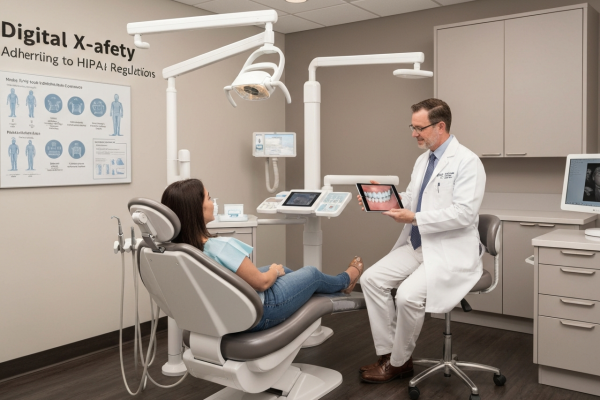
Now, I put the image on a monitor right in front of you. I can circle the issue. We can look at it together. When you can see exactly what is happening inside your tooth, you feel more empowered to make decisions about your treatment. It takes the mystery out of dentistry.
If you want to read more about the official guidelines and safety protocols, the American Dental Association provides excellent resources on this topic. You can check out their detailed guide on X-ray safety and patient health here.
Common Myths About Dental Radiation
Even with the facts, myths persist. Let’s bust a few of them right now.
- Myth: “If I don’t feel pain, I don’t need an X-ray.”
Fact: Many dental issues, like cysts, bone loss, and early decay, are painless. X-rays see what you can’t feel. - Myth: “Dental X-rays cause headaches.”
Fact: There is no scientific evidence linking digital dental X-rays to headaches. The energy is directed solely at the jaw. - Myth: “I should avoid X-rays entirely to be healthy.”
Fact: avoiding X-rays can lead to undiagnosed infections that are far more dangerous to your overall health than the negligible radiation exposure.
Frequently Asked Questions
Are digital dental X-rays safe during pregnancy?
Yes, they are generally considered safe. However, we always exercise extreme caution. If you are pregnant or think you might be, tell me immediately. While the radiation is minimal, we usually postpone non-emergency X-rays until after the baby is born just to be extra safe. If there is an emergency (like a severe infection), we use double lead aprons to protect the baby.
How often do I really need X-rays?
It depends on your dental history. If you have a mouth full of fillings and are prone to cavities, I might suggest them once a year (bitewings). If you have perfect oral hygiene and no history of decay, we might only take them every 18 to 24 months. I customize the schedule for every patient.
Why do you leave the room if it’s so safe?
This is a great question! You only get X-rays once or twice a year. As a dentist, I take X-rays all day long, every day. If I stood next to the machine for every patient, my cumulative exposure over 30 years would be high. Leaving the room is simply a workplace safety precaution for my staff and me.
Do digital X-rays cost more?
Generally, the cost to the patient is very similar to traditional film. Insurance companies cover them the same way. The investment is mostly on the dentist’s side to buy the sensors and computers.
Your Health is My Priority
I hope this post has helped clear up the confusion surrounding Dental X-Rays Radiation. Technology has come a long way, and I am thrilled to offer my patients a diagnostic tool that is fast, accurate, and incredibly safe.
My goal is always to catch issues early so we can fix them easily. Digital imaging makes that possible. If you haven’t had a check-up in a while, or if you have been putting it off because of radiation fears, I invite you to come in. Let’s take a look at your smile together on the big screen.
Ready for a safe, modern dental experience? Feel free to contact my office to schedule your appointment. I look forward to seeing you soon!